Core capabilities with an optional paid add-on
Workforce & Business Operations
Customer, credential and workforce operations for public safety and field services. Connect the site, customer, contract, qualified crew, deployment, actual work, invoice and internal cost instead of running each step in a separate system.
Core capabilities with an optional paid add-on
Contacts, preplans, certification compliance and deployment time capture are included in the core platform. Customer invoicing, online payments, contractor billing, Cal OES MARS cost recovery and Workforce costing are offered as the paid Business Ops add-on.
What this capability delivers
Designed around the real operational work already managed in Resgrid.
Contacts, sites and preplans
Maintain people, organizations, service locations, access notes, hazards, alert notes and attachments that can surface during dispatch and record authoring.
Billing and cost recovery
Create rate cards, contracts, bids, invoices, payments and aging from calls or deployments, including contractor DTRs and Cal OES MARS preparation and status tracking.
Certification compliance
Define credential requirements for roles and Units, monitor expiry, evaluate qualified staffing and preserve the certification snapshot used for an assignment.
Workforce and resource costing
Compare revenue with protected loaded labor and resource cost, preserve estimate-versus-actual snapshots and support controlled pay-data reporting workflows.
How work moves through Resgrid
From the first operational fact to a complete, auditable outcome.
Start with the customer, agency, or site
Maintain the person or organization once, then attach service locations, access instructions, hazards, preplans, files, billing profile, contracts, and notes. Dispatch and Records use the same source instead of copying it.
Build a qualified deployment
Create a deployment from an opportunity, contract, resource order, Call, or mutual-aid request. Resgrid evaluates required roles, person and Unit certifications, availability, and expiry before preserving the selected roster snapshot.
Capture the work that happened
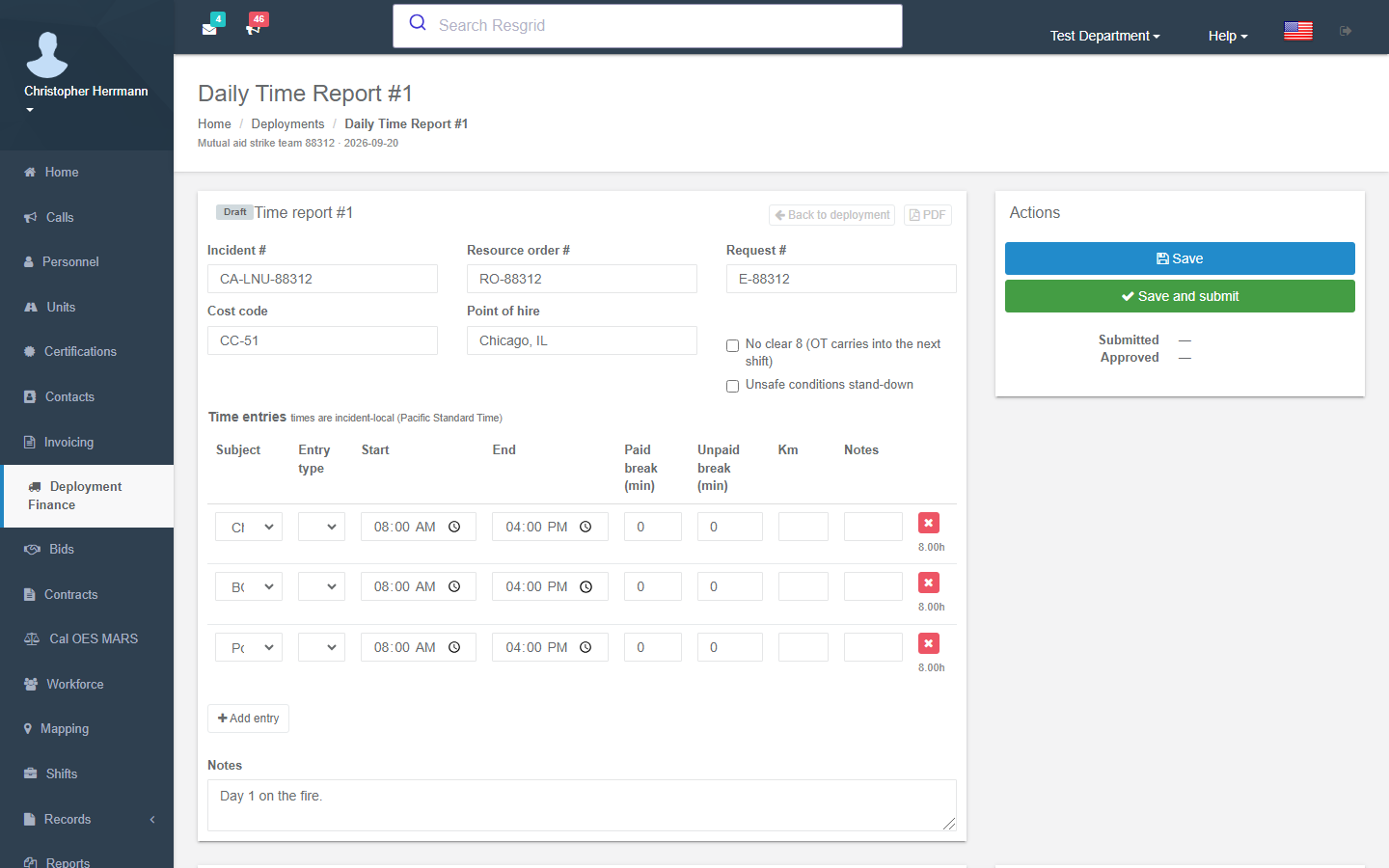
Record mobilization, travel, standby, incident, demobilization, labor bands, equipment use, distance, expenses, approvals, and daily time reports. Reviewed work records remain the billing and costing authority.
Turn approved facts into billing and recovery
Apply the effective rates, contract, taxes, minimums, discounts, guarantees, or mutual-aid profile; generate source-linked invoice lines; deliver the invoice; record payments; and manage reimbursement state.
Compare recovery with protected actual cost
Authorized users compare revenue with approved loaded labor and resource cost snapshots. Missing rates or stale assumptions create review exceptions rather than silently treating unknown cost as zero.
Technical and operational depth
Designed around lifecycle, authority, evidence and failure modes—not only screens.
Contacts, organizations, sites, and preplans as shared facts
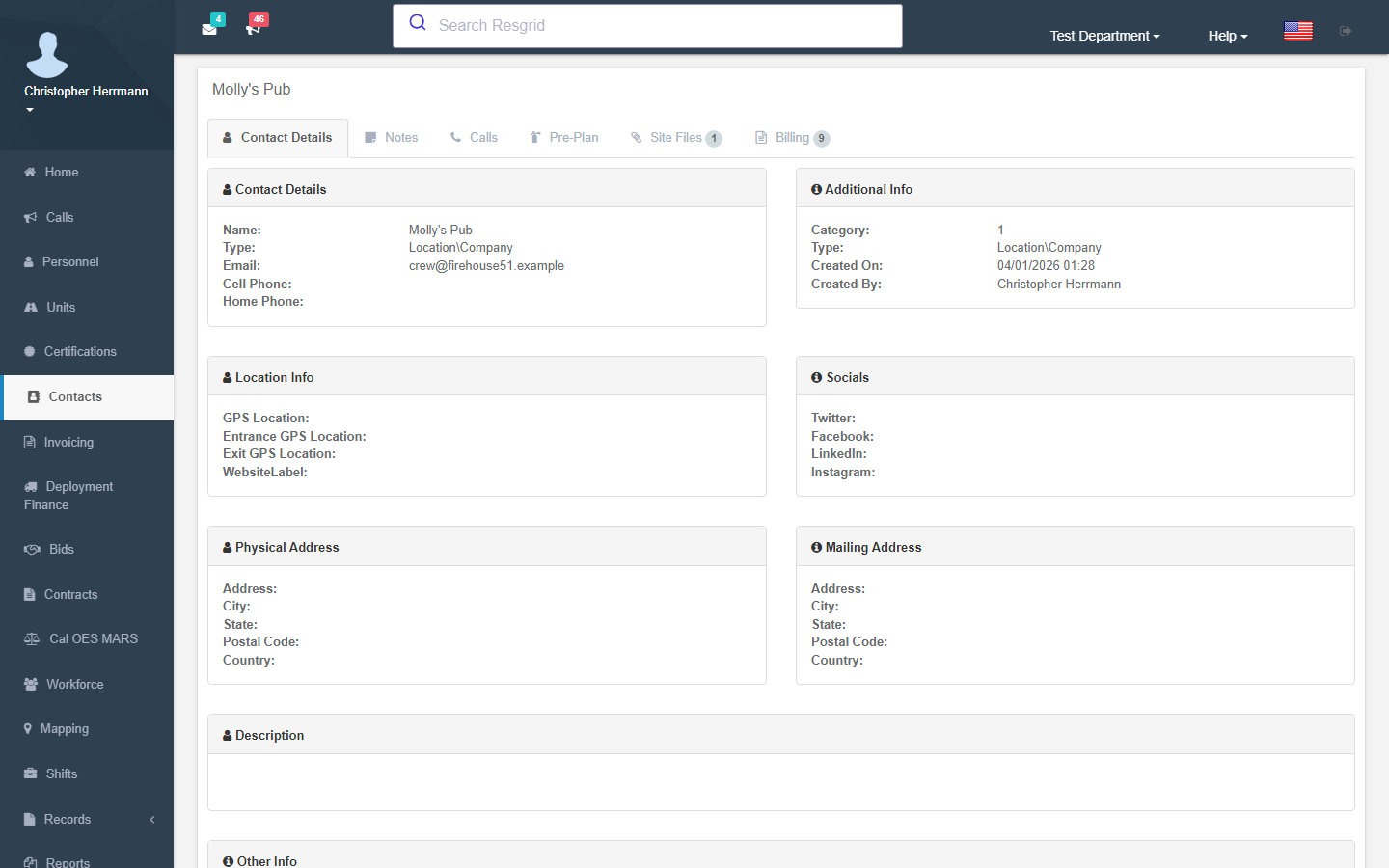
A Contact can represent a person or organization and relate to multiple locations, notes, categories, files, hazards, access instructions, and billing settings. The same governed source surfaces during dispatch, response, Records, contracting, and invoicing.
- People, organizations, relationships, service sites, contacts, categories, and active dates
- Site access, hazards, alert notes, preplan attachments, occupancy context, and dispatch summaries
- Billing profile, tax identity, payment terms, discounts, invoice recipients, and contracts
- Versioned notes and files with scoped permissions, audit history, and sensitive-data controls
- RMS consumes approved snapshots while Contacts remains authoritative for future changes
From rate schedule and deployment to defensible invoice
Billing is driven by approved operational facts and effective-dated terms. Rate schedules, bids, contracts, deployment rosters, time reports, equipment usage, expenses, taxes, minimums, and supporting documents remain linked to the invoice they produced.
- Versioned rates for labor, Units, equipment, mileage, travel, standby, guarantees, and premiums
- Bid-to-contract-to-deployment conversion without re-keying customer, scope, crew, or rates
- Invoice generation from approved Calls or deployments with editable reviewed lines and sources
- Payments, partial balances, aging, overdue status, voids, PDFs, delivery, and reconciliation
- Bounded Cal OES MARS/CFAA preparation, F-42 evidence, expected recovery, and manual portal handoff
Qualification and workforce cost without exposing payroll data
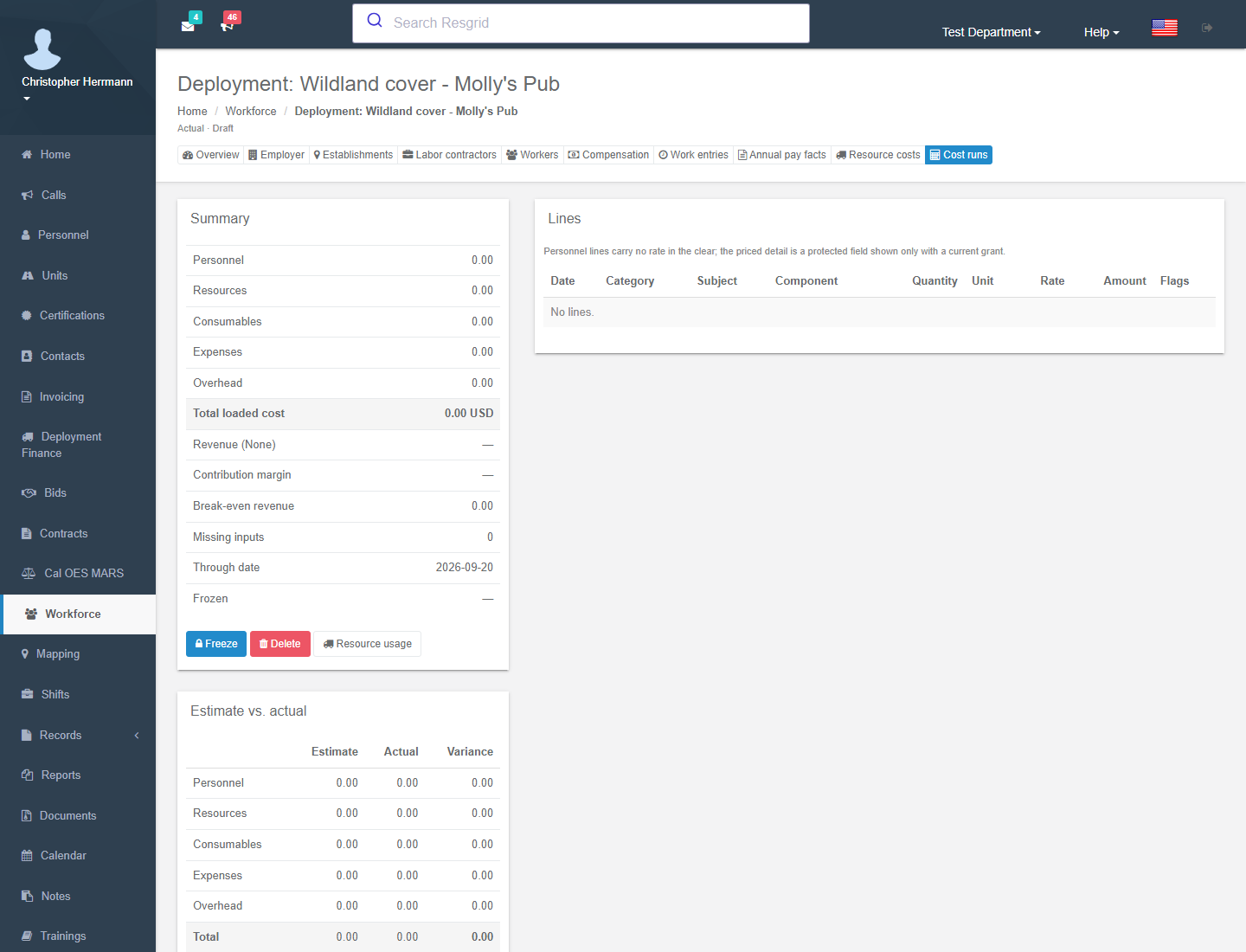
Typed requirements evaluate whether a person or Unit is qualified at assignment time. A separately protected workforce model calculates loaded labor and resource cost without placing compensation on ordinary rosters, manifests, or operational screens.
- Credential types, issuers, numbers, effective and expiry dates, files, credits, renewal, and status
- Role and Unit requirements, expiry alerts, qualification matrices, enforcement, and snapshots
- Employment, establishment, job assignment, pay components, work facts, and provenance under protection
- Resource cost for fuel, maintenance, tires, depreciation, insurance, lease, storage, and operations
- Estimate-versus-actual cost, contribution margin, exceptions, and controlled Pay Data exports
One connected operating picture instead of another data silo
Other options
CRM, accounting, credential spreadsheets, scheduling and job-costing products each keep a different copy of the customer, site, worker and job. Staff reconcile them manually before billing, qualification review or reimbursement.
The Resgrid approach
Resgrid connects the Contact and preplan used at dispatch to the same Call, qualified crew, deployment, time report, equipment usage, invoice and protected cost record. Operational facts flow forward with review instead of being re-keyed.
What this can replace or consolidate
Reduce separate systems without hiding where specialist tools still belong.
Separate customer and preplan lists
Use one Contact and site record from dispatch through service delivery, Records, contracting, billing, and follow-up.
Credential and qualification spreadsheets
Replace manual expiry filters and roster checks with typed requirements, alerts, matrices, and assignment-time evidence.
Basic invoicing and A/R trackers
Generate, deliver, age, reconcile, and trace operational invoices without rebuilding work in a generic accounting form.
Deployment time and job-cost spreadsheets
Keep roster, time, equipment, expense, revenue, and protected actual-cost evidence attached to one deployment.
Built into the Resgrid system
The feature connects with Calls and Dispatch, Personnel, Units and staffing, Shifts, Calendar, Inventory, Maintenance and Work Orders, RMS, Workflows and Advanced Data Protection. Incident Back Office finance is coming soon.
Contacts & Preplans
Dispatch & Calls
Personnel & Units
Shifts & Calendar
Deployments
Inventory & Readiness
Records / RMS
Protected Data
Important scope and system boundaries
Clear limits prevent another vague all-in-one promise.
This is not payroll processing or an HRIS
The feature uses approved work and annual pay facts for costing and controlled reporting. It does not calculate payroll, withhold taxes, administer benefits, classify workers legally, or transmit payroll.
MARS support uses a bounded manual gateway
No reviewed public write API exists. Resgrid prepares, validates, links evidence, calculates recovery, and tracks observed status without screen-scraping credentials or claiming automatic portal submission.
Sensitive workforce data has built-in safeguards
Compensation, demographic, and annual reporting facts use dedicated permissions, fresh authorization, value-free audit, and controlled export—never a plaintext fallback.
Less duplicate work, more time and budget back
Organizations can reduce duplicate customer and workforce records, shorten invoice preparation, catch credential gaps before assignment, improve reimbursement evidence and understand operational cost without stitching together multiple subscriptions and spreadsheets.